Masters of Form: How Soccer Shaped Seattle — and Finally Brought the World Cup Home
Part of our ongoing Masters of Form series.
Usually this series is about architects. We've written about the people who drew the lines this region now lives inside - the ones who decided what a Northwest house should feel like, how a skyline should meet the water, where a porch belongs.
This time the master of form isn't a person. It's a game.
Hear me out. Architecture is about how a place organizes people and feeling into something physical. By that definition, soccer is one of the most influential designers Seattle has ever had. It filled a stadium before the city had a football team to put in it. It rebuilt a neighborhood's identity. It gave a famously reserved town a reason to scream in unison on a Saturday afternoon. And this June, it's handing Seattle the biggest stage on Earth.
So here's the building Seattle didn't know it was drawing for fifty years.
The game arrived in work boots
Long before any of this, the game came over on boats. Seattle in the late 1800s was a working town full of new arrivals, and a lot of them carried soccer with them as casually as a lunch pail. British and Welsh coal miners filled the company towns south and east of the city (Black Diamond, Newcastle, Carbonado, Renton) and on their days off they did what they'd done back home, which was find a flat patch of ground and pick sides. Scandinavian loggers, mill hands and fishermen who packed neighborhoods like Ballard added to the mix. Soccer here started as an immigrant's habit, not a promoter's idea.
It organized fast. By 1908 there was a Pacific Coast league running up and down the water from Victoria to Seattle, its rulebook copied straight from the English and Scottish associations. By 1910 kids were playing in Seattle schools, starting around Green Lake, and within a few years those coal-town teams were strong enough to dominate the local leagues outright. None of it made headlines the way baseball did. But the roots were already deep, and they were European, working-class, and stubborn, which is exactly the kind of foundation that holds.
It started with a name pulled from a contest
The original Seattle Sounders were born in December 1973, when the North American Soccer League decided to push west and handed franchises to Seattle and Vancouver. Portland followed a year later, and just like that the Cascadia rivalry had its foundation poured.
The team needed a name, so the owners ran a public contest. More than 3,000 entries came in. "Sounders" won. One of the names given? "Mariners," which the city would get around to using eventually.
They played their first seasons at Memorial Stadium at Seattle Center, and the response was immediate in a way nobody expected. On June 22, 1974, the Sounders drew 13,876 fans and recorded the first sellout in NASL history. Six sellouts came that first summer. This was a brand-new sport in an American city that supposedly didn't care about it, and people kept showing up.
A lot of that early roster was English, and those players quietly taught the city the vocabulary, that the field is a pitch, that a nil-nil draw can be thrilling if you know where to look. Coaches John Best and later Jimmy Gabriel also did something smart: they built a reserve system that pulled in local kids. West Seattle's Jimmy McAlister signed at 19 and was named the league's Rookie of the Year in 1977. The team belonged to the place, and the place knew it.
The night Pelé came to the Kingdome
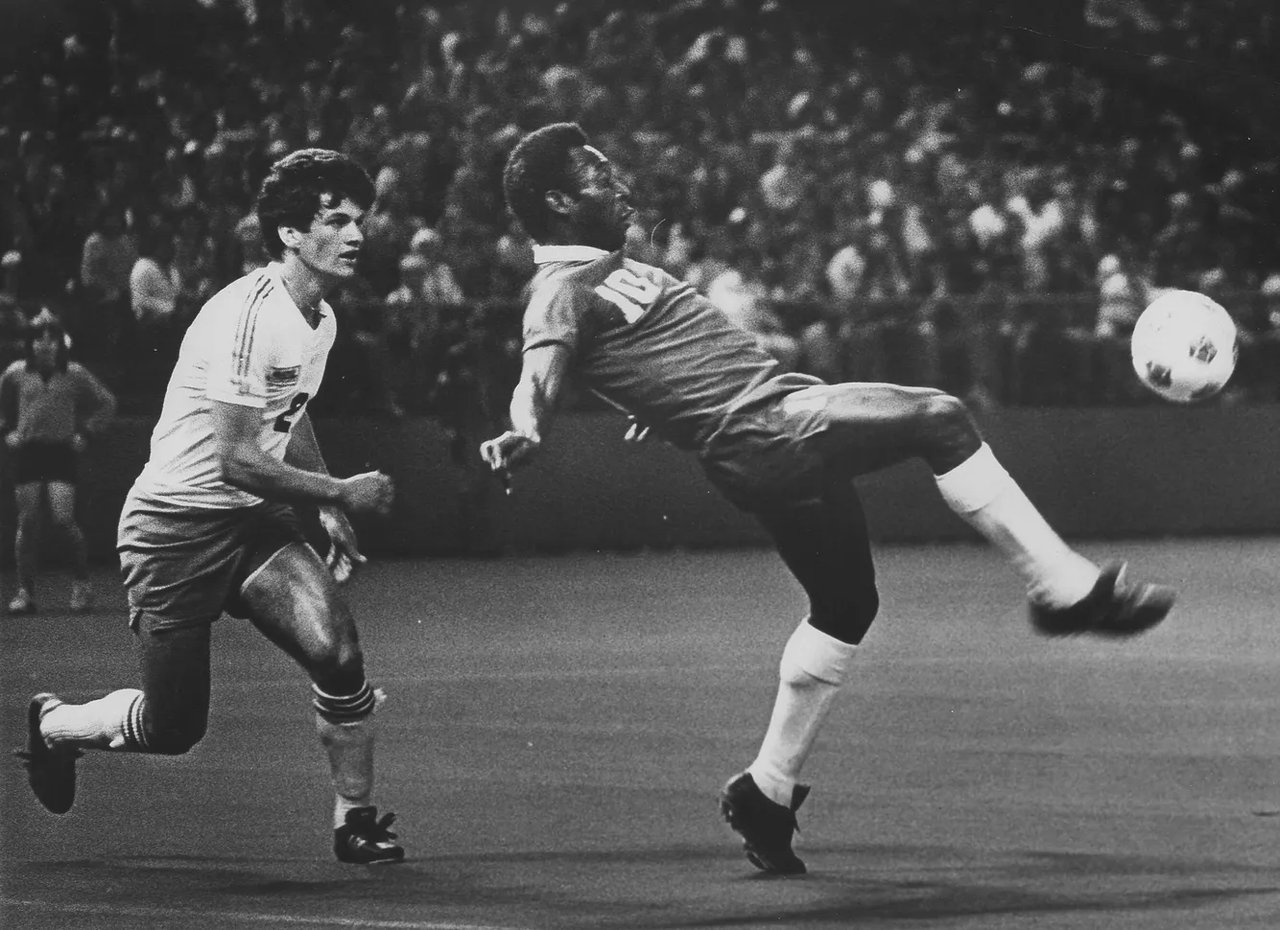
When the Kingdome opened in 1976, the Sounders were part of its very first sporting event - an exhibition against the New York Cosmos and Pelé, the most famous athlete alive. The crowd: 58,128. At the time it was the largest soccer audience the United States had ever seen.
For about five years the Sounders were genuinely one of the best stories in the league, averaging more than 20,000 a night in a cavernous concrete dome and twice reaching the Soccer Bowl final. They lost both, in 1977 and 1982, to those same New York Cosmos, which is the kind of heartbreak that makes a fan base loyal rather than fickle.
Then the NASL collapsed under its own spending, and the Sounders folded in 1983. The whole league was gone a year later. Ten seasons, a Pelé sellout, two finals, and then nothing.
The long detour
Seattle didn't forget. Through the late '80s and into the '90s the Puget Sound region kept patching together teams, the Tacoma Stars indoors, the Seattle SeaDogs, a few others that came and went. In 1994 the Sounders name was revived for a lower-division club, and that team did the unglamorous work of keeping professional soccer alive here while the city built its case.
That case had a problem, and it was an architectural one. When Major League Soccer launched in 1996, Seattle was an obvious market, but the city had no soccer-friendly home to put a team in. The Kingdome was aging, and a stadium nobody wanted to play in is a stadium that doesn't get a franchise.
The fix arrived from an unlikely direction. In 1997, Washington voters approved a referendum to build what's now Lumen Field. The legislation authorizing it specifically named the FIFA World Cup as something the building should be able to host someday. Read that again: the stadium was written, on paper, for the exact thing happening this summer. Sometimes the form really does precede the function by thirty years.
2009, and the building came unglued
The modern Sounders entered MLS in 2009 with an ownership group that included Hollywood producer Joe Roth, Microsoft money, and (memorably) Drew Carey, who pushed for the supporter-driven traditions that now define matchdays. The March to the Match. The Emerald City Supporters in the south end. A team you could vote on.
The numbers were absurd from day one. Seattle became the first MLS club to average more than 30,000 fans a game, then kept climbing past 43,000 while most of the league hoped for half that. The Sounders racked up a sellout streak that ran for years and rewrote the league's attendance record book several times over.
The trophies followed. An MLS Cup in 2016. A second in 2019, won at home in front of 69,274 against Toronto, a stadium record. A run to the 2020 final. And in 2022, the biggest one yet: the Sounders beat Pumas UNAM of Mexico to become the first MLS club ever to win the CONCACAF Champions League, with 68,741 packed in for the final leg.
Through most of it, the man on the sideline has been Brian Schmetzer, a Seattle kid who grew up alongside the original Sounders and ended up coaching the city to its golden era. The full circle is almost too neat.
And it isn't only the men. Seattle Reign FC has carried the city in the NWSL, making Lumen Field one of the rare American venues that's serious about top-flight soccer for both. In 2025 the building hosted Club World Cup group matches against Paris Saint-Germain, Atlético Madrid and Botafogo, drawing more than 132,000 across three nights, and the Sounders won the Leagues Cup in front of a new club-record crowd against Inter Miami. The dress rehearsals kept getting bigger.
Why a real estate column cares about a stadium
Because Lumen Field changed the map, and we love soccer. The building anchors SoDo, sitting between downtown and the working waterfront, a short walk from Pioneer Square and a quick ride from almost anywhere on the light rail. A neighborhood that was warehouses and rail yards is now the front door to the city's biggest events, and the gravity of that has pulled development, restaurants and housing demand toward it for two decades.
It's also, by reputation, the loudest stadium on the planet. Lumen is home of the seismographic "Beastquake", where 69,000 people are making more sound than a jet engine when a ball hits the net. So let's just say that this piece of property is great for entertaining.
Seattle Stadium, June 2026
For the next several weeks, Lumen Field doesn't exist. FIFA rules strip host venues of their corporate names, so the building is simply Seattle Stadium for the duration of the tournament, fitting, honestly, for the thing it was always meant to do.
Seattle is one of sixteen host cities across the United States, Canada and Mexico for the first World Cup on this continent since 1994, and the city drew six matches between June 15 and July 6. Belgium and Egypt open the schedule on June 15. On June 19, the United States plays Australia here at noon, a host-nation match in a building that knows how to bring it. Bosnia-Herzegovina meets Qatar on June 24, Egypt faces Iran under the lights on June 26, and then the stage gets heavier with a Round of 32 fixture and a Round of 16 knockout, where the stakes are high.
This is the largest sporting event Seattle has ever hosted. Half a century ago a few local businesspeople ran a name-the-team contest and prayed somebody would buy a ticket. This month the rest of the world arrives to watch the best players alive in a stadium the city wrote into law before it had a team good enough to fill it.
The architects in this series shaped how Seattle looks. Soccer shaped how it feels. And for a few weeks this summer, the whole planet gets to stand inside the form.